A Room That Has Fainted
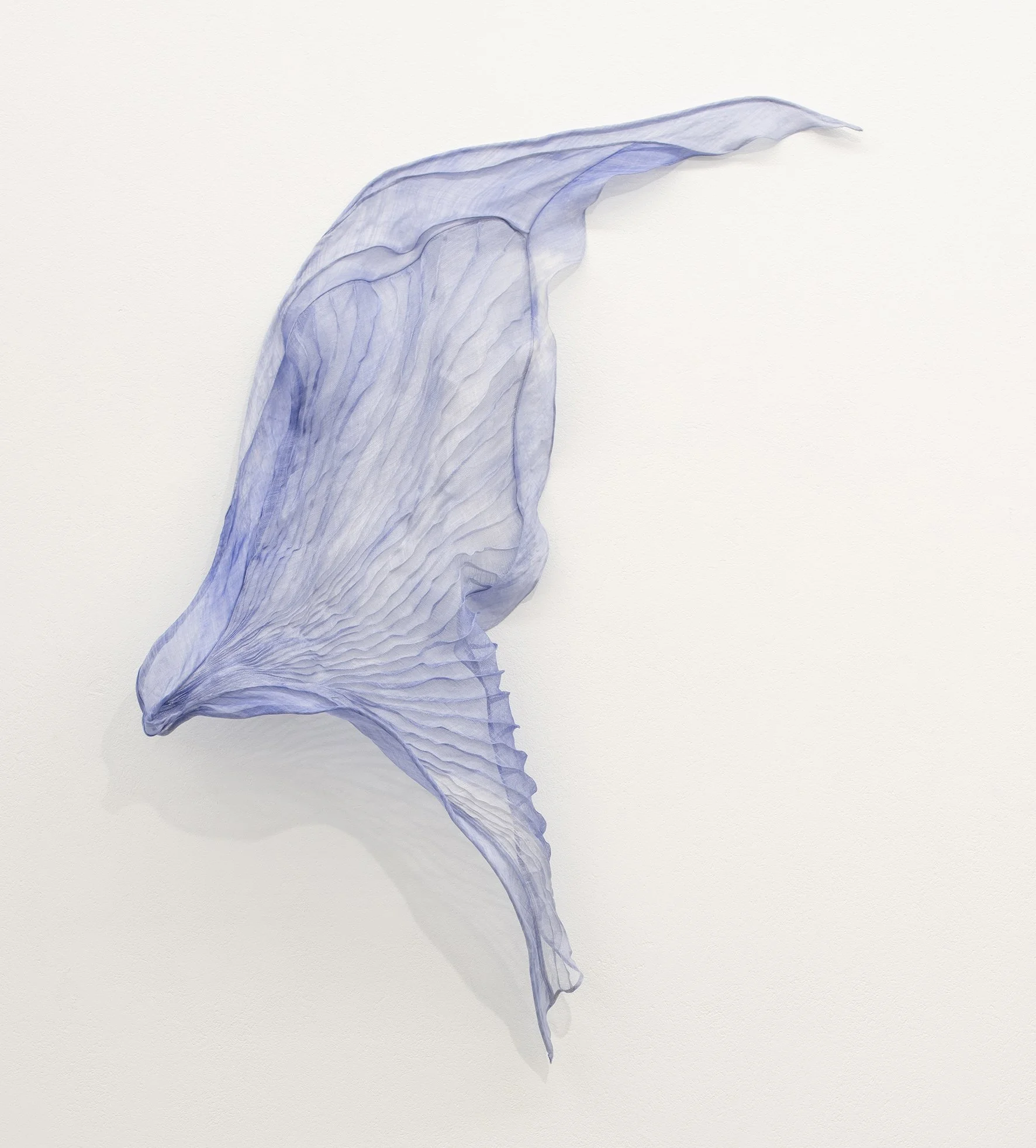
Diana Orving’s works often inhabit a space between fragment and whole. Forms emerge as individual elements while also belonging to larger constellations. They reach towards one another, establish connections, and open up spatial relationships that cannot always be grasped from a single vantage point. What appears as a coherent form from one angle may dissolve and reconfigure from another.
Textile is central to Orving’s practice, not merely as a material but as a way of thinking through the hands and through repeated gestures. There is a profound trust in the openness of the working process. Rather than following a predetermined plan, the works evolve through careful attentiveness to the possibilities and resistances of the material. A bend, a shift, or an unexpected point of balance is not a departure from the idea but the very path towards it. Colors, too, emerge as part of the same investigation; Orving often dyes her materials with pigments she mixes herself, allowing their tones to develop in dialogue with the material. Here, intuition is not the opposite of precision but a way of giving form to what cannot yet be fully articulated. Each decision grows out of those that came before, while also opening up new directions.
Looking back, Orving sometimes describes her works as diary entries. Not because they recount specific events, but because they carry traces of who she was at the moment they came into being. Something of the experience, the energy, and the attentiveness invested in their making remains embedded within the material.
There is one book that Diana Orving returns to time and again as a companion: Inger Christensen’s alphabet (publ.1981; English transl. 1991). It contains words that feel almost tactile, images that resonate deeply. Certain phrases linger and resurface throughout the process of making. One of them is “a room that has fainted.” Perhaps this striking image also captures something essential in Orving’s practice. Not a room that has lost its stability, but one in which boundaries momentarily dissolve, where the relationships between body and world, matter and thought, come into view in new ways.
In alphabet, Christensen writes the world into being through an inventory of what exists: plants, animals, weather phenomena, language, and celestial bodies. The poem follows the order of the alphabet and the Fibonacci sequence, in which each new number arises from those before it. The individual reveals itself as part of a larger cycle.
A similar sensitivity to interconnectedness runs through Orving’s work. Not as an attempt to depict nature, but as an experience of being part of the same movements that animate it. A seed already contains the future plant. One form gives rise to another. What first appears separate reveals itself to be profoundly connected.
The cosmic is present in these works, though rarely as something distant or unattainable. Rather, it appears as an interplay between the inner and the outer, between the human and that which exceeds it—a reminder that the boundaries we perceive as fixed may be far less stable than they seem.
Nor do the works end where the materials do. Light allows their forms to extend as shadows and reflections across walls and floors, while the materials respond even to the subtlest movements of their surroundings. The ephemeral becomes part of the works themselves. Wholes emerge only to dissolve once again.
It is precisely there that Diana Orving’s works take form. Like a room that, for a brief moment, opens itself to something greater than itself.
Tessa Praun
Curator & Writer, The Wanderlust Institute of Art